
Home > Use Cases > Use Case #1
Use Case #1: Crowd Management During Events
This use case explores how AI models can monitor crowd movements, predict bottlenecks and risks, and recommend measures to improve safety and flow at large events such as SAIL Amsterdam 2025.
Background
The larger the event, the more complex it becomes to manage visitor flows effectively. An event such as SAIL Amsterdam attracts hundreds of thousands of visitors to the city each event day. Crowd managers therefore require real-time insight into pedestrian and traffic flows, including short-term forecasts, to ensure safety, smooth flow, and a positive visitor experience.
Traditional traffic models fall short in this context. They struggle to account for unpredictable human behaviour, depend on historical data that is often unavailable, and are not well suited for real-time applications. AI offers new opportunities: it can detect patterns in large and diverse datasets, adapt to new situations, and generate both short- and long-term predictions.
Objective
In this use case, we develop and test AI models for real-time crowd monitoring, short-term forecasting, alerts, and scenario planning, with SAIL Amsterdam 2025 as the primary test environment.
The focus is on improving insight into current crowd levels, supporting real-time interventions. The methods and insights developed are intended not only for SAIL, but also for other large-scale events, such as King’s Day.
Approach
SAIL Amsterdam 2025 serves as the first test environment for the Amsterdam Events digital twin, which will be further developed across multiple events. This digital twin acts as a central platform where data, visualisations, and AI models come together to support operational decision-making.
In the operations centre, the SAIL organisation, the Municipality of Amsterdam, and the Amsterdam-Amstelland Safety Region work together to monitor safety and crowd flow during the event.
Role of Observations and Interpretation
Field observations play an important role as a reference point within this use case. Measurements and observations of pedestrian and traffic flows are used to understand the current situation and to interpret and validate AI predictions and simulations.
This practical foundation enables the integration of multiple data sources into a single common operational picture, with visualisations that can be directly used for crowd management.
Activities
The use case draws on a wide range of data sources, including those from SAIL Amsterdam, the Municipality of Amsterdam, and the Amsterdam-Amstelland Safety Region. These data—ranging from event programmes and planning data to sensor data, social media, and weather information—are collected and integrated.
Analyze, TU Delft, and UCrowds are responsible for the (further) development of simulation, estimation, and prediction models. These models are iteratively tested and improved using both historical and real-time data.
A Data Protection Impact Assessment (DPIA) has been carried out to ensure responsible data use.
In addition, there is a strong focus on learning and knowledge sharing, including training sessions and evaluations with involved professionals.
_____
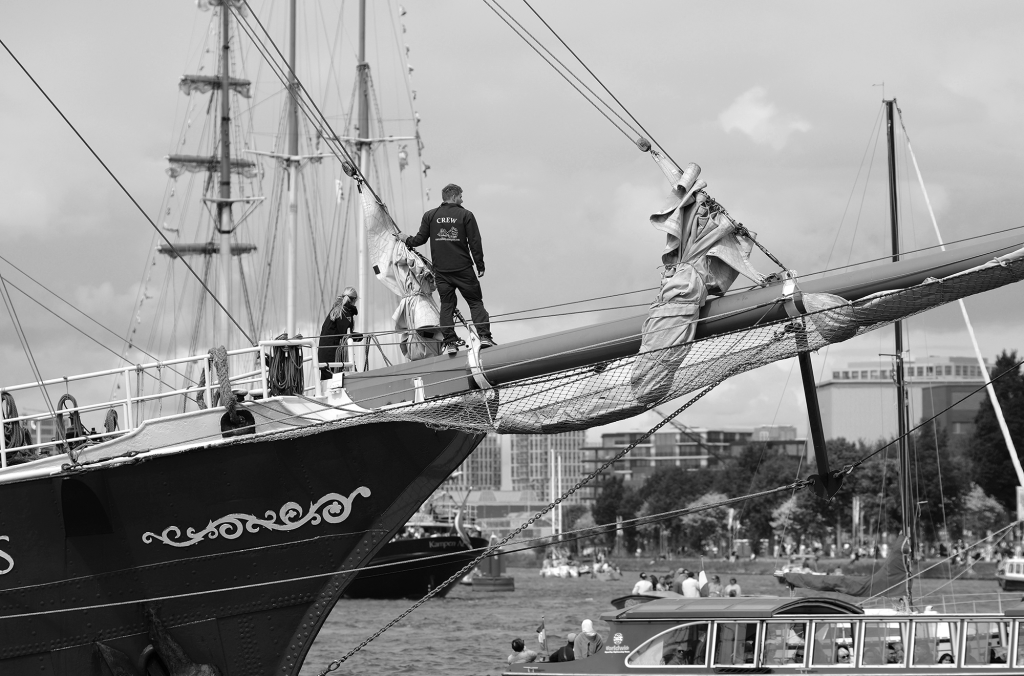
Photo credits: Dmitrii E. on Unsplash
Who
Analyze, TU Delft, UCrowds, Gemeente Amsterdam, SAIL Amsterdam, Veiligheidsregio Amsterdam-Amstelland
When
2025-2026
Download this use case in pdf format.