

TU Delft has incorporated elements of the AiMTT use case Crowd Management During Events into two courses of the Master’s programme in Transport, Infrastructure and Logistics. More than thirty students worked on designing (course TIL4030) and building (TIL6022) smart AI solutions for crowd management.
TIL4030
The aim of the course TIL4030, Research and Design Methods, within the TIL programme, is to introduce students to research and design methodologies in the domain of Transport, Infrastructure and Logistics — and to apply them in practice. Students attend lectures and apply their knowledge in a realistic group assignment.
In the first quarter of the 2025–26 academic year, 36 out of 100 students chose the SAIL case, directly derived from the AiMTT use case Crowd Management During Events.
The “SAIL students” worked, among other things, on conceptual designs for monitoring dashboards for pedestrian flows. These dashboards are intended to help crowd managers identify problems, predict flows, and evaluate interventions. Several designs were delivered, and the students also explored implementation challenges, such as data collection, staff training, and safeguarding the privacy of SAIL visitors.
Another group of SAIL students focused more specifically on crowd management itself. They mapped out the stakeholders involved in crowd management and analysed their interests, requirements, and needs. Based on this analysis, they determined which “functions” a crowd management approach should include and how these functions could be implemented. For example, gaining insight into visitor flows may require the use of cameras, portable radios, and phone tracking, while steering flows may require tools such as signage and digital screens.
TIL6022
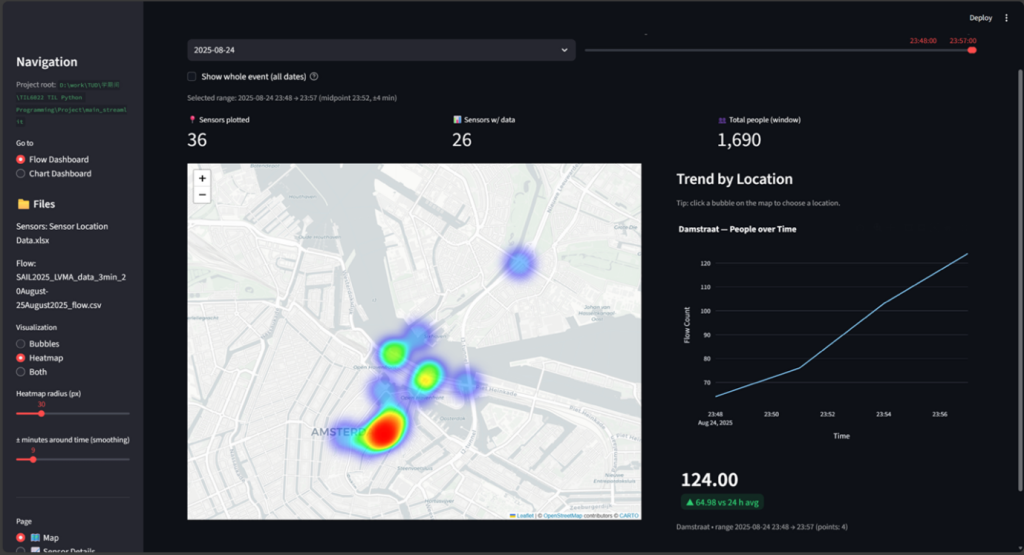
In the parallel course TIL6022, Python Programming, the SAIL students were able to further develop the designs created in TIL4030. The assignment was to create a crowd monitoring dashboard and/or build a short-term crowd prediction model.
The students worked in six groups of six. Most teams chose to combine both assignments. This resulted in interactive dashboards that not only displayed real-time information but also included crowd forecasts.
The data used mainly consisted of sensor counts from the Crowd Management System Amsterdam (CMSA), made available by AiMTT partner Municipality of Amsterdam. These data were supplemented with weather information collected via the KNMI website. Most groups successfully applied an XGBoost machine learning model for their predictions.
Each group chose its own approach, resulting in a wide variety of dashboard designs. Different forms of data visualisation — such as trend lines for crowd predictions, maps with crowd hotspots, and statistical graphs per sensor — as well as different crowd management focuses — such as exploratory pattern analysis, anomaly detection, and warning generation — provided valuable input for the development of future dashboards.
Challenging but Educational
For many students, this was their first introduction to AI models. Overall, they found the experience challenging but highly educational, as it required them to apply their newly acquired skills to a practical problem.
“The TIL4030 and TIL6022 joint project provided an interesting and engaging approach for the first group work of the master’s,” says student Inés Blanes Martín-Posadillo. “It allowed us to conceptualise a design and, at the same time, bring it to life. Both the design and the end product were developed simultaneously, which created what could be called ‘feedback loops’ between the processes. For example, a design decision that worked well in the research and design phase sometimes had to be modified to fit programming capabilities and the project’s time constraints.”
_____
Photo credits (student working on laptop): Dylan Ferreira on Unsplash