
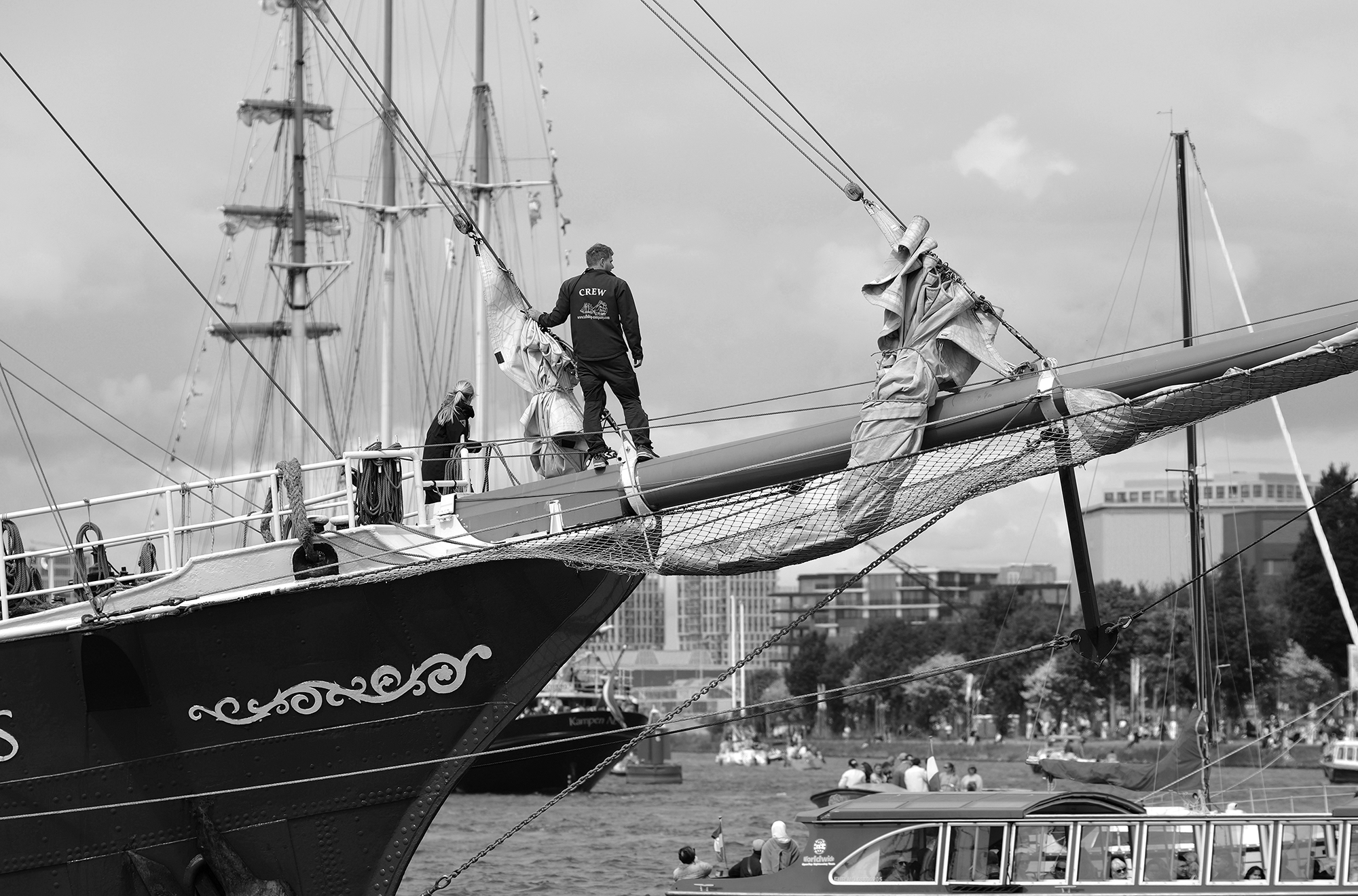
During the most recent edition of SAIL Amsterdam, significant progress was made on the AiMTT use case Crowd Management During Events. Among other achievements, the partners developed an AI model capable of predicting pedestrian crowd levels several hours in advance. Parts of the use case have now been incorporated into the Master’s programme in Transport, Infrastructure, and Logistics at TU Delft.
The large-scale maritime event SAIL Amsterdam took place in August 2025 and attracted 2.5 million visitors to the Dutch capital. For AiMTT, this provided an ideal opportunity to gain knowledge and hands-on experience in monitoring and managing large pedestrian flows. These activities were carried out within the Crowd Management During Events use case.
First result: predictive model
This use case is built on traffic and crowd data provided by AiMTT partners including the City of Amsterdam, Veiligheidsregio Amsterdam-Amstelland, and SAIL Amsterdam.
Using this input, other AiMTT partners developed some promising tools. Analyze worked on an AI model that generates alerts when bottlenecks arise in the transport network, covering both vehicle traffic and pedestrian flows. UCrowds focused on building a pedestrian simulation model. And TU Delft developed a forecasting model that predicts pedestrian crowd levels up to several hours ahead.
The data and the initial results of these tools were made accessible and visualized in a digital twin of the event area. This twin was piloted during SAIL in the so-called “boiler room”: a space adjacent to the operational control center where innovations were developed and demonstrated.
Challenge: no historical data
One challenge of this SAIL-focused use case was that the AI tools could not be trained on historical data, as it was the first SAIL event in ten years. But the partners found som interesting solutions. For example, to predict pedestrian flows, TU Delft researchers developed an adaptive hybrid AI model that learns from live sensor, weather, and event data.
The hybrid architecture combines a periodically retrained LightGBM model with a Kalman filter for real-time error correction and 90% prediction intervals calibrated using Conformalized Quantile Regression. This approach proved capable of delivering robust forecasts up to four hours in advance.
Importantly, this method is highly transferable to crowd management at other large-scale events — especially those with little or no historical data available.
Further development in master’s courses
This first AiMTT use case is therefore well underway. At the same time, every result generates new questions, ideas, and opportunities for improvement. For this reason, parts of the use case have been integrated into two courses within TU Delft’s Master’s programme in Transport, Infrastructure and Logistics (TIL).
In both TIL4030 – Research and Design Methods and TIL6022 – Python Programming, students are currently working on real-world challenges related to the AiMTT use case around SAIL. More than thirty students are participating in these courses. Their results will be shared with the AiMTT learning community at a later stage.
_____
Photo credits: Dmitrii E. on Unsplash